

SHARE
EZEKIEL PHALANA
ADDITIONAL INFO SUPPLIED AND PICTURES
South African parents recognise the importance of planning for their children’s education, but new research from FNB highlights a significant gap between intention and long-term preparation.
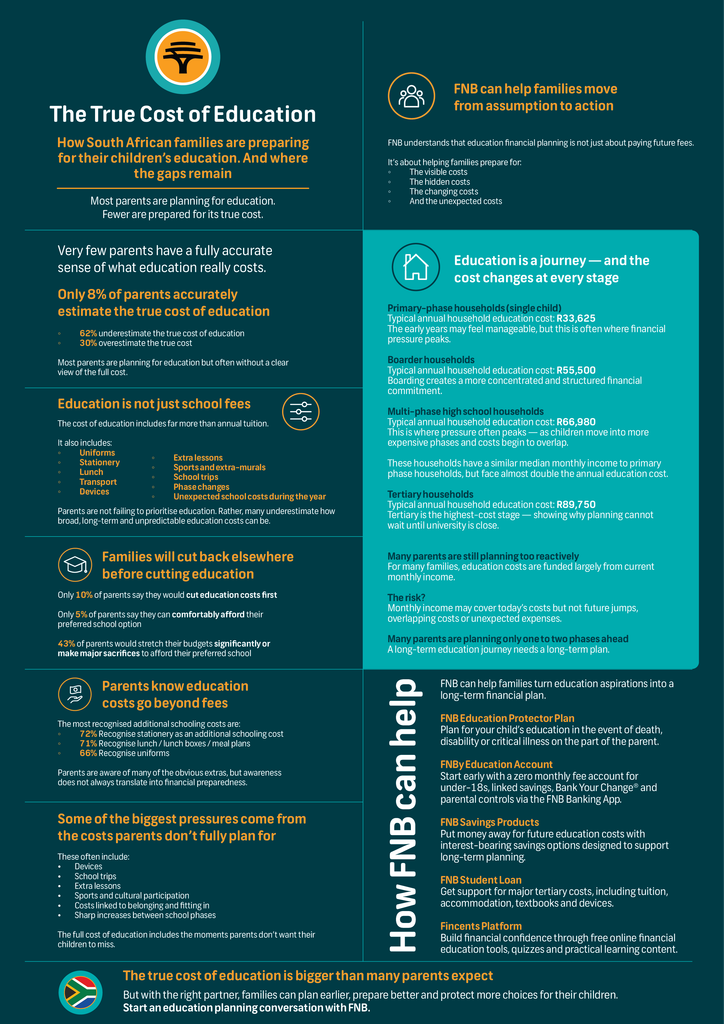
FNB’s inaugural Education Insights Survey found that 86% of parents are planning for education costs, yet only 49% have a clear and structured strategy in place. The survey also found that 70% of parents, in hindsight, would have done something differently, with many wishing they had started saving earlier or put more money aside.
The findings demonstrate that education costs extend well beyond tuition fees. Uniforms, stationery, transport, technology, extra-mural activities, tutoring and school trips can place additional pressure on household finances, making it increasingly important for families to consider the full education journey when planning.
Despite education being a priority, many parents continue to plan over relatively short periods. Nearly one in four parents are planning only one to three years ahead, while 58% have plans extending to tertiary education and beyond.
The survey further shows that approximately 60% of parents primarily rely on their monthly salaries to meet education-related expenses, while fewer than one in three use dedicated education savings or investment products.

Matthew Green, Product Portfolio Manager at FNB Life Insurance, says the research highlights the difference between parents recognising the need to plan and having a structured approach to meeting future education costs.
“The survey shows that while 86% of parents are actively thinking about education costs, fewer than half have a clear strategy in place to fund those costs over the long term.”
Green says starting early, establishing a structured plan and reviewing it regularly can help families prepare for rising education costs and reduce financial pressure later.
The research also indicates that parents with structured plans tend to start earlier and think further ahead. They are more likely to use dedicated savings, investment or protection products and generally have greater confidence in their ability to meet future education costs.
However, confidence can decline as children progress through their education, particularly when parents consider the potential cost of tertiary education alongside broader cost-of-living pressures.
Himal Parbhoo, CEO of FNB Insurance, says education planning should be viewed as a long-term financial commitment rather than simply a series of annual school expenses.
“Planning for education means thinking about the entire journey, not just school fees. Good financial planning should consider both the costs that emerge along the way and what happens when life does not go according to plan.”
Parbhoo also points to the importance of protecting education plans against unexpected events. While many parents have general financial safety nets, these may not specifically protect a child’s education if a family experiences a major life event.
FNB Life Insurance recently introduced the FNB Education Protector Plan, which allows parents to make provision for their children’s education in the event of death, disability or critical illness. The solution is supported by an education cover calculator designed to help parents estimate their future education funding needs.
Ultimately, FNB says education planning is about more than paying school fees. It is about preparing for the complete educational journey, protecting opportunities and helping families build greater financial confidence around their children’s future.
FNB plans to release its Education Insights research annually, with the findings available through an eBook aimed at helping South African families better understand and prepare for the full cost of education.